

The Róth Who Ran Away to the Theater
Kálmán Róth, known on stage as Pesti Kálmán
1869–1944 or 1945 (exact date unresolved)
A Family Falls Apart, 1873
In 1873, a financial panic swept through Pest and struck the Róth family glass business. Architectural historian Tibor Gottdank describes Zsigmond Róth, who had spent nineteen years fighting his way to the status of free master glazier in a guild that had resisted admitting him, as losing his business in what Hungarians simply called a nagy krach — the great crash. The Jewish orphanage provided the family with two rooms at Hold utca 4. Zsigmond’s wife, Mária Duller, suffered what Gottdank described as her mind “breaking down” under the strain.
But newly located primary records suggest that what happened afterward was more complicated than a simple descent into poverty and dispersal.
Hungarian researcher Roy C. Grant, who contacted me after the original publication of this story, identified a series of Budapest notarial and court records concerning the family. In 1877, Zsigmond and Mária entered into an out-of-court settlement involving another Budapest glazier, Ignác Márkus. Another record that year describes Zsigmond as a merchant.
The paper trail becomes even more intriguing in 1878 and 1879. Zsigmond entered into a lease agreement with his mother-in-law, Regina Duller, widow Haslinger. Then, in January 1879, Regina executed a formal deed of gift in favor of her minor granddaughter Márta Róth. Zsigmond appears in the deed explicitly as Márta’s father and legal guardian and accepted the gift on her behalf.
Attached to that deed is something remarkable: an inventory comprising 134 numbered lots of glass merchandise, dated January 5, 1879.
The documents do not tell us, at least not yet, why these assets were being transferred within the family. They may reflect ordinary family property arrangements, an attempt to reorganize the glass business after the crash, continuing financial difficulties, or something else entirely. What they do show is that the Róths’ economic circumstances after 1873 were more complex than the surviving family narrative alone suggests.
An 1883 property lawsuit adds another piece to the puzzle: Zsigmond and Mária were named as defendants in litigation concerning 1,927 forints 20 kreuzer connected with a purchase-and-sale transaction. Again, the catalog entry establishes the litigation but not its relationship, if any, to the earlier glass transactions.
What is clear is that the children’s lives eventually moved in very different directions. Helén went to America. Miksa remained in the glass trade and became one of Hungary’s most celebrated stained-glass and mosaic artists. And the youngest son, Kálmán, ran away from home and became a wandering actor.
This is his story, as much of it as the record allows.
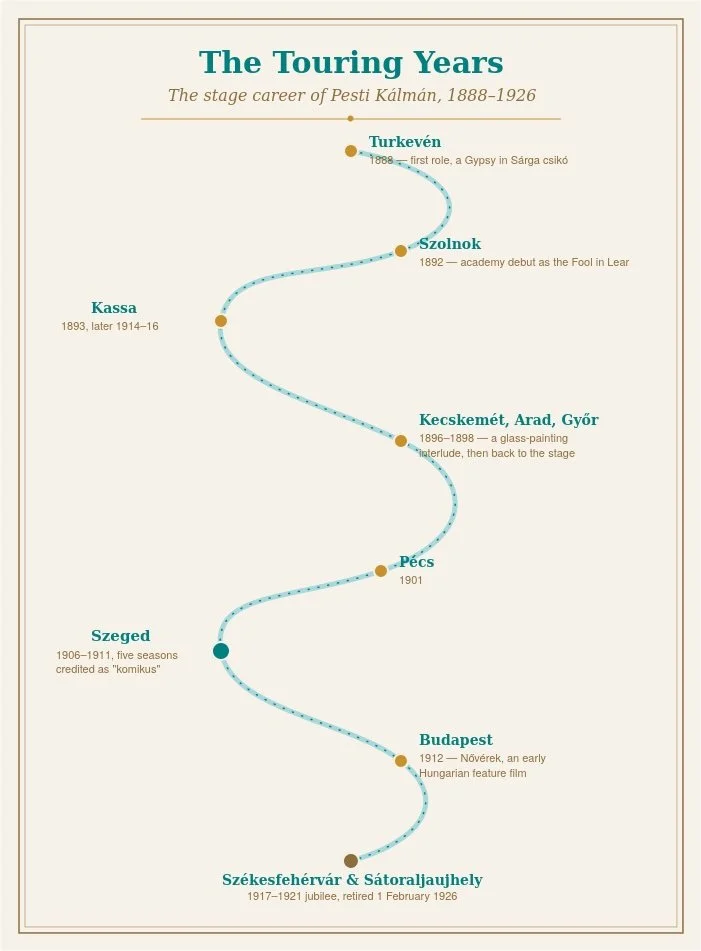
The touring years: the stops of a thirty-eight-year stage career, from a runaway debut in Turkevén in 1888 to retirement in 1926.
Birth and Origins
Kálmán Róth was born in Pest on December 21, 1869, the son of Zsigmond Róth and Maria Duller, who had married in Pest on November 16, 1856. His birth was recorded in the Jewish birth registers under the religious name Kálmán Wolf, a common pairing of a civil name with a separate Hebrew name. His father, Zsigmond, was by then the last guild master of the united Pest glaziers’ guild and the father of a family that would eventually produce two internationally recognized glass artists in Miksa and his brother Manó. Kálmán’s path led elsewhere, though, as it turned out, not quite as cleanly as the family split might suggest.
Running Away to the Theater, 1888
Kálmán finished secondary school and, rather than settle into a trade, ran away from home. In the summer of 1888 he joined a traveling theatrical troupe performing in Turkevén, taking his very first role: the Gypsy in a folk play called Sárga csikó (“The Yellow Foal”). It was the beginning of a stage career that would run, with a few detours, for nearly forty years.
He soon grew restless with that itinerant company and enrolled instead at Budapest’s acting academy, today the Színház- és Filmművészeti Egyetem, as a member of the “Drámai színész (régi)” class of 1888–1892. After completing his training, he contracted with actor-manager Pál Rakodczay and made his formal academy debut in March 1892 in Szolnok, in a role that would recur throughout his career: the Fool in King Lear.
A Detour Into Glass
For a time, in the middle of his touring years, Kálmán’s acting career faltered financially; the lexicon says simply that he “went bankrupt,” and he turned, at least briefly, to glass painting: the very trade his father and brothers had built their lives around. It didn’t last. His heart, as the record puts it, pulled him back to the painted world of the stage, and he returned to acting for good.
It’s a small, telling detail: Zsigmond Róth’s sons, Miksa and Manó, are remembered as the family’s glass artists, and Kálmán as the actor, but for a stretch of his life, the line between those two paths blurred.
A Career on the Road, 1892–1911
For the better part of two decades, Kálmán Róth, now performing as Pesti Kálmán, “Kálmán of Pest,” a stage name announcing the city of his birth, moved through the touring circuit that supplied Hungary’s provincial towns with theater. Across the surviving lexicon accounts of his career, one from the Magyar Elektronikus Könyvtár’s digitized reference edition, the other from Volume 3 of Aladár Schöpflin’s 1930 Magyar Színművészeti Lexikon, his engagements can be traced through Győr, Szombathely, Nyitra, Kassa, Sátoraljaújhely, Nyíregyháza, Arad, Makó, Zombor, and Baja, before he signed in 1893 with Imre Halmay’s well-regarded company in Kassa. From there the record continues: the Óbuda Kisfaludy Theatre in the summer of 1893; Losonc that winter; Kecskemét in 1896 under Bakodczay; Leszkay’s company in Arad in 1897; Dobó Sándor’s company in Győr in 1898; a stint at the Népszínház in Budapest; Relle István’s company from 1899 to 1901; Pécs under Tiszay Dezső in 1901; Albert Kövessy’s company in 1902–3 and again in 1905; and, for five consecutive seasons from 1906 to 1911, Lajos Makó’s company at the National Theatre of Szeged.
The Szeged years are independently confirmed by the theatre’s own published company rosters, which list Pesti Kálmán by name in every season from 1906–07 through 1910–11. In that final Szeged season, he is credited specifically as “komikus,” comedian. His fellow company members that year included a young actor billed as Lugosi Béla in the men’s chorus, quite possibly, though not conclusively established, the same Béla Lugosi who would later leave Hungary for Hollywood and become Dracula.
The lexicon entries sum up the shape of his career: a dramatic actor, a “pedantic comic” who also had a taste for tragic material, the Fool in King Lear was a role he returned to across his career, and, as both performer and director, one of the notable figures of provincial Hungarian theater. His other documented roles include Polilla, Lancelot Gobbo in The Merchant of Venice, Biberach, Tóth bácsi, Cochenille in Offenbach’s Tales of Hoffmann, the Critic in Ferenc Molnár’s The Guardsman, Lothár in Varázskeringő, Plumpudding in Jenő Huszka’s Bob herceg, and Zsupán in Strauss’s The Gypsy Baron.
Playwright, Critic, and Editor
Kálmán’s relationship to the theater world went well beyond acting. He tried his hand at playwriting, producing at least two works of his own: A hetedik (“The Seventh,” an operetta in three acts with music by Richárd Kun), which premiered 1 April 1909 in Szeged, and a one-act piece called Szelemlek. He also wrote a string of monologues, Nem házasodom! (“I Won’t Marry!”), Nem megyek férjhez! (“I Won’t Get Married!”), and A jó fiú (“The Good Son”), published in the trade journal Színészeti Közlöny in 1900.
Alongside his stage work, he was a working theatrical journalist and critic, contributing numerous pieces to the Pécsi Napló, Győri Hirlap, Színészeti Közlöny, Alföld, and Szegedi Hirlap. He was, by the account of the lexicon itself, a member of its own editorial staff, meaning Kálmán Róth helped compile at least part of the very reference book that preserves his biography today.
A Turn Before the Camera, 1912
In 1912, between his Szeged and Kassa engagements, Kálmán appeared in Nővérek (“The Sisters”), a production of the Uher Filmgyár directed by Andor Garvay and the younger Ödön Uher. At roughly 890 meters of film, Nővérek is counted among the very first feature-length Hungarian films, its claim to that distinction rivaled only by Mihály Kertész’s Ma és holnap, released the same season. Kertész would later reach Hollywood as Michael Curtiz.
No print of Nővérek survives. A full review of the September 1912 issue of Színházi Hét, the magazine that covered the film’s press premiere, includes production photographs and detailed coverage of the film and its leading players, but no mention of Kálmán by name and no photograph of him among the surviving images. His presence in the film is documented only through a later filmography, not through contemporary press coverage.
The Comic’s Comic: A Specialty in Ape Impressions
A separate reference work, the 1929–31 Magyar Színművészeti Lexikon, edited by Aladár Schöpflin, preserves an unexpectedly specific detail. In a general essay on “the versatile actor,” under a passage devoted to performers known for impersonating apes on stage, a recognized variety-theater specialty of the era, the text credits the well-traveled Ede Klischnigg with making the act famous, notes that Árpád Dunay later excelled at it as well, and closes with a single parenthetical name: (Pesti Kálmán.)
It is a small thing, but it rounds out the picture of a working comic actor who built a recognizable reputation, however modest, in the touring theater of his day.
Later Career and Retirement, 1913–1926
Kálmán’s later engagements took him to the short-lived Új Színpad in Budapest in 1913, back to Kassa under Ödön Faragó from 1914 to 1916, to Székesfehérvár in 1917–18, and to Sátoraljaújhely, where on 10 February 1921 he celebrated his thirty-year stage jubilee. He retired from the stage on February 1, 1926, closing out a career of roughly thirty-eight years, dating from his first role in Turkevén in 1888, almost all of it spent in the touring provincial theater that formed the backbone of Hungarian dramatic life outside Budapest.
Death Amid the Vészkorszak
What happened to Kálmán after his retirement in 1926, and exactly when and how he died, remains unresolved.
Family tradition places his death around 1945. The National Archives of Hungary, in a 2014 article about his brother Miksa, states that Kálmán, along with their brother Manó and nephew Artúr Elek, fell victim to the vészkorszak, the Holocaust era in Hungary, around the period of Miksa’s death in June 1944.
For a time, another record seemed to offer a tantalizing alternative.
A Kálmán Róth, born in the 1860s and buried in Budapest’s Kozma Street Jewish Cemetery, died in 1935. The similarity in name, age, city, and cemetery made him difficult to dismiss, and in the original version of this article I left open the possibility that this might have been Pesti Kálmán.
Then Hungarian family-history researcher Roy C. Grant contacted me with evidence that appears to resolve the question.
Grant identified a Budapest death record for the Kálmán Róth who died in 1935. That man was a married Jewish tinsmith whose parents were recorded as Adolf Róth and Netti Hoffmann.
He was not the Kálmán I was researching.
That discovery eliminates what had looked like a plausible burial record and reminds us of one of genealogy’s most persistent traps: the person with the right name, approximately the right age, in exactly the right city can still be the wrong person.
So the mystery returns to where it began.
Kálmán Wolf Róth, Pesti Kálmán, actor, director, playwright, critic, editor, occasional glass painter, early film actor, and apparently accomplished impersonator of apes, disappears from the documentary trail after his retirement.
Whether he died during the Holocaust, as the Hungarian National Archives account indicates, or at another time and under circumstances not yet documented remains an open question.
For now, I would rather leave that question unanswered than give him someone else’s death.
Sources & Research Notes
Acknowledgment
I am grateful to Roy C. Grant, a longtime researcher of Hungarian family history, for providing more information after this article's original publication. Grant identified the 1935 death record that distinguishes the Kálmán Róth buried at Kozma Street Jewish Cemetery from Kálmán Wolf Róth/Pesti Kálmán, and he brought several Budapest notarial and court records concerning the Róth and Duller families to my attention.
His findings prompted me to revisit both Kálmán’s unresolved death and my description of the Róth family’s circumstances following the financial crisis of 1873. This revised version reflects that additional research.
Selected sources supporting the principal claims in this story.
1. Hungary, Jewish Birth Records collected by Rabbis in Various Counties, 1789–1921. Entry for Kalman Roth, b. 21 December 1869, Pest, Local Government, Pest-Pilis-Solt-Kiskun, Kingdom of Hungary; father Zsigmond; mother Maria Duller; religious name recorded as Kalman Wolf. Ancestry.com.
2. Hungary, Jewish Marriage Records from Various Counties, 1800–1914. Entry for Maria Duller, age 23, married Sigmund Rott, 16 November 1856, Pest; father Jacob Duller, who also witnessed. Ancestry.com.
3. Magyar Színházművészeti Lexikon, s.v. “Pesti Kálmán” (Budapest, n.d.), Országos Széchényi Könyvtár, Magyar Elektronikus Könyvtár. Provides birth date, training, career-by-year listing 1893–1921, notable roles, playwriting credits, and 1926 retirement.
4. Aladár Schöpflin, ed., Magyar Színművészeti Lexikon [Hungarian Dramatic Arts Encyclopedia], vol. 3: Komlóskert–Püspöki Imre (Budapest, 1930), s.v. “Pesti Kálmán,” p. 463. Provides fuller detail on his 1888 Turkevén debut as the Gypsy in Sárga csikó, his March 1892 academy debut in Szolnok as the Fool in King Lear, his interlude as a glass painter, precise dates for A hetedik’s premiere (1 April 1909, Szeged) and his 30-year jubilee (10 February 1921, Sátoraljaújhely), his journalism for the Pécsi Napló, Győri Hirlap, Színészeti Közlöny, Alföld, and Szegedi Hirlap, and his membership on the lexicon’s own editorial staff. Digitized at Arcanum Digitheca, Magyar Színművészeti Lexikon collection.
5. Színház- és Filmművészeti Egyetem (SZFE), archívum, hallgató: Pesti Kálmán, osztály: “Drámai színész (régi), 1888–1892.”
6. Gottdank Tibor, “Dinasztiák: az üveges Róthok — Miksán innen és túl,” Építészfórum, 6 June 2021. Describes the 1873 financial crash, the family’s residence at Hold utca 4, Maria Duller Róth’s breakdown, and the scattering of the family’s seven children, including Kálmán’s flight into itinerant acting.
7. Sándor János, A szegedi színjátszás krónikája: A kőszínház és társulatainak története (1883–1944), Somogyi-könyvtár, Szeged. Company rosters naming Pesti Kálmán for the 1906–07 through 1910–11 seasons under director Makó Lajos and, from 1909–10, Endre Almássy; credited by role (“komikus”) in 1910–11.
8. Hangosfilm.hu, filmográfia, “Nővérek” (1912), Uher Filmgyár. Cast list including Pesti Kálmán; production and premiere details; note on the film’s status as one of the earliest Hungarian feature-length productions and the absence of a surviving print.
9. Színházi Hét, 1912, 3. évfolyam, 30. szám (15–22 September 1912), full issue examined page by page. Contains the press-premiere review and production photographs of Nővérek but no mention of Pesti Kálmán by name and no photograph of him; also contains no reference to him elsewhere in the issue.
10. Aladár Schöpflin, ed., Magyar Színművészeti Lexikon (Budapest, 1929–31), s.v. “Sokoldalú színész,” vol. 4, p. 0154; database edition by B. Kádár Zsuzsanna and Nagy Péter Tibor (Szociológiai dolgozatok №8., WJLF, Budapest, 2017), Magyar Elektronikus Könyvtár. Names Pesti Kálmán among actors noted for stage impersonations of apes. Same encyclopedia as source 4 above, different volume.
11. Magyar Nemzeti Levéltár, Reisz T. Csaba, “Róth Miksa címeres üvegablakai a levéltárban,” 13 June 2014. Names Kálmán and Manó Róth as Miksa Róth’s brothers and states that both, along with nephew Artúr Elek, fell victim to the Holocaust era (vészkorszak) at approximately the time of Miksa’s death in June 1944.
12. Find a Grave, memorial for Kalman Roth (b. 1869, d. 1935), Kozma utcai izraelita temető, Section 38A, Row 31, Grave 36, Kőbánya, Budapest, memorial ID 168237769. Death date not reconciled with family tradition (1945) or the Archives’ account (c. 1944); possible conflation with brother Manó Róth, who is independently recorded as dying in 1935 and being buried in the same cemetery.
Online Sources
Magyar Színházművészeti Lexikon, Pesti Kálmán
Építészfórum, Dinasztiák: az üveges Róthok
Sándor János, A szegedi színjátszás krónikája, Társulati névsorok
Magyar Nemzeti Levéltár, Róth Miksa címeres üvegablakai a levéltárban
Find a Grave, Kalman Roth memorial
Research note: an extensive search across Hungarian theatrical, film, and archival sources, including a full page-by-page review of the September 1912 issue of Színházi Hét, has not yet turned up a surviving photograph of Kálmán Róth.
What stories are hidden in your past? At The Untold Branch, I help people tell them.